Cute Cat Face Heart Nose Design
First Impression: Sweet, Simple, and Stitch-Ready
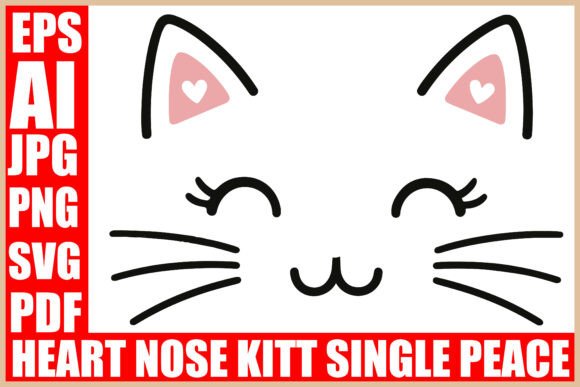
When I opened Cute Cat Face Heart Nose Design, my first thought wasn’t “cute”—it was “clear.” The minimalist kawaii-inspired silhouette reads instantly: two rounded ears, soft cheek curves, gentle eyes, and that unmistakable heart-shaped nose. It’s not fussy. There are no tiny whiskers to vanish in thread, no layered gradients to complicate digitizing, and no fine linework that risks stitching out as a muddy blob. That clarity is gold for embroidery designers—it means fewer test runs, less re-hooping, and faster turnaround on client work or shop inventory.
A Real Project Test: Embroidering a Linen Baby Tote Bag
Last week, I used Cute Cat Face Heart Nose Design on a natural linen tote for a boutique baby gift set. The fabric had subtle texture and zero stretch—ideal for clean satin-stitch definition—but it also showed every stitch imperfection. I hooped it with medium-weight cutaway stabilizer, chose a soft peach thread for the face and deep rose for the heart nose, and ran it at standard density. What emerged was exactly what the design promised: friendly, cohesive, and tactile without looking stiff. Parents loved how the heart nose popped—not too literal, not too abstract—just warm enough to feel personal. That’s the quiet strength of this design: it adds emotional resonance without demanding attention.
Where It Shines (and Where It Needs Care)
Cute Cat Face Heart Nose Design performs beautifully on stable, medium-weight fabrics—think cotton tees, canvas totes, twill aprons, and brushed poly sweatshirts. Its compact shape (roughly 2.5–3 inches wide) fits comfortably in common hoop sizes and avoids the distortion issues you see with oversized motifs on curved surfaces like caps. As a machine embroidery design, it translates well to applique design workflows too—swap the fill stitch for a smooth satin border and use the heart nose as a focal fabric accent.
But here’s where judgment matters: avoid using it on ultra-thin knits (like lightweight jersey) without additional tear-away stabilizer underneath, and steer clear of dense, napped fabrics (terry cloth, heavy fleece) unless you reduce stitch density manually. On dark fabric, test thread contrast early—the heart nose needs enough luminosity to read as intentional, not accidental shadow. And while it works on baby embroidery and holiday embroidery alike, skip placing it near high-friction zones like bag handles or pillow corners unless you reinforce stitching or add a backing patch.
What It Adds to Your Finished Product—Beyond Cuteness
This isn’t just decoration. Cute Cat Face Heart Nose Design elevates handmade product perception. On an Etsy listing for embroidered tea towels, it signals care—not just craft, but curation. For small shop owners, it supports brand consistency when paired with simple typography or coordinating motifs (think tiny hearts or paw prints). Customers recognize its sincerity: it doesn’t shout; it invites touch and smile. That builds trust, especially for personalized gifts or custom apparel where emotional connection drives repeat sales.
I’ve seen similar designs fail because they overcommit—too many details, too much density, too much “personality” crammed into a small space. This one holds back just enough. The absence of eyelashes, pupils, or mouth lines keeps it versatile across age groups and contexts: nursery decor feels tender, not childish; wedding guest favors feel whimsical, not juvenile; craft fair patches feel collectible, not generic.
Practical Designer Notes You’ll Actually Use
- Always test on scrap fabric first—especially if switching from cotton to rayon or blending stabilizer types.
- Check thread color contrast in natural light *and* under store lighting—what reads softly on screen can disappear on oatmeal-colored sweatshirts.
- Review stitch density before scaling up: larger versions may need adjusted underlay or reduced fill to prevent puckering.
- Confirm hoop size compatibility—this design fits most 4x4 hoops comfortably, but double-check your machine’s usable area.
- Inspect small details at 200% zoom in your embroidery software—make sure the heart nose edges are smooth, not jagged or pixelated.
- Test black-and-white mockups to assess silhouette strength—this design holds up beautifully in monochrome, which matters for screen printing backups or grayscale printable mockups.
- Compare light vs. dark fabric backgrounds before finalizing thread choices—rose thread sings on ivory linen but fades on charcoal.
- Use proper stabilizer: medium cutaway for knits, tear-away for wovens, and fusible + cutaway for lightweight blends.
- Verify licensing before selling finished items or bundling the digital embroidery file with other design assets—commercial use rights aren’t automatic, even for Crafts category graphics.
Final Thought: A Quiet Workhorse in Your Design Toolkit
Cute Cat Face Heart Nose Design won’t go viral. It won’t dominate your portfolio page. But it will sell—consistently—on baby onesies, boutique aprons, teacher appreciation mugs (as an iron-on transfer), and heartfelt holiday embroidery gifts. It’s the kind of embroidery file that disappears into the product just enough to feel effortless, yet stays memorable enough to make someone pause and say, “Oh—I *love* that little cat.” For Etsy sellers, craft business owners, and embroidery professionals who value reliability over flash, this is more than a graphic. It’s a thoughtful, stitch-savvy shortcut to warmth, wearability, and real-world appeal.