Cute Cat in Ugly Christmas Sweater SVG
As a designer who’s stitched over 200 holiday-themed embroidery files for clients, boutiques, and Etsy sellers—and who’s also ruined more than one sweatshirt trying to force a “cute but complicated” design—I approached the Cute Cat in Ugly Christmas Sweater SVG with equal parts curiosity and caution. My real test? A batch of organic cotton tote bags for a local gift shop’s holiday pop-up. No mockups. No safety net. Just me, my Brother Innov-is NQ3500D, and the pressure of delivering 48 finished pieces by Thursday.
First Impressions: Joyful, Not Juvenile
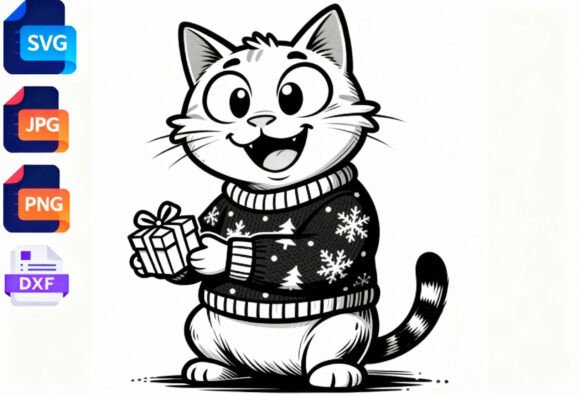
This isn’t a cutesy kitten wearing tinsel—it’s a confident, slightly smug cat draped in a deliberately chaotic sweater: candy canes, snowflakes, tangled lights, and a crooked reindeer face. The silhouette is clean and bold, with generous negative space around the cat’s outline—exactly what you want for machine embroidery. There’s no tiny facial detailing that’ll vanish in satin stitch, no overlapping lace motifs that beg for 12 thread changes. It feels festive without leaning into kitsch overload. That matters when your customer is a 32-year-old graphic designer buying a gift for her *own* mom—not a toddler’s onesie.
Where It Shines: Real Projects, Real Results
The Cute Cat in Ugly Christmas Sweater SVG lands beautifully on mid-weight fabrics where stitch definition holds up: heavyweight cotton sweatshirts, twill tote bags, linen tea towels, and denim aprons. I ran it on a fleece-lined baby blanket (with tear-away + cut-away stabilizer), and the sweater’s texture read clearly—even the “ugly” elements had personality, not mush. For small business owners, this design bridges whimsy and wearability: it reads well at 3.5"–4.5" wide, fits cleanly in a 4x4 hoop, and translates instantly into an embroidered patch or iron-on applique.
Etsy sellers will appreciate how easily it layers into product bundles: pair it with “Merry & Bright” script fonts for a holiday set, or use the SVG version to create printable mockups showing the design on mugs, pillows, and sweatshirts. As a digital embroidery file, its clean vector paths mean scaling up for a pillow cover (6") or down for a cap front (2.75") doesn’t degrade edges—critical if you’re offering custom sizing as a service.
Where to Pause—and Plan Ahead
Don’t rush this onto stretchy jersey tees or thin baby bodysuits without testing. The sweater’s dense fill areas—especially the zigzag “ribbing” and clustered ornaments—can pull fabric if stabilizer isn’t matched precisely. On dark fabric, avoid light thread unless you’re using underlay or topping; the cat’s white fur needs contrast to stay legible. And skip curved surfaces like baseball caps unless you’ve confirmed the design’s height stays under 2.25"—the sweater’s horizontal width dominates, and crowns compress detail.
Also: while the SVG and EPS formats are perfect for digitizing your own version, remember—the supplied file is a graphics bundle, not a pre-digitized embroidery file. If you’re new to converting vectors for machine use, budget time (or budget for a digitizer) to adjust stitch density, add underlay to prevent puckering on knits, and simplify any fine lines that won’t resolve at 300 DPI output.
What It Adds to Your Finished Product—Beyond Cute
Customers don’t buy “a cat.” They buy nostalgia, inside jokes, shared holiday chaos. This design delivers that with authenticity—not forced cheer, but warm, wink-at-the-ridiculous energy. When stitched cleanly, it elevates a plain tote into a conversation starter and boosts perceived value: buyers pay more for handmade products that feel intentional, not algorithmically generated. For craft businesses, that trust compounds—repeat buyers return because your embroidery looks professional, consistent, and joyful, not rushed or pixelated.
I’ve seen similar designs fail on Etsy listings because the digital preview didn’t match the stitched result. With the Cute Cat in Ugly Christmas Sweater SVG, the transparent PNG gives accurate color blocking, and the SVG lets you preview exact proportions before digitizing—so your mockups align with reality. That consistency builds brand credibility faster than any banner ad.
Practical Designer Notes—No Fluff, Just What Works
- Always test first: Stitch on scrap fabric matching your final project’s weight, stretch, and color—even if it’s “just a tote.”
- Check thread color contrast: Try black thread on cream fabric *and* white thread on navy. The cat’s expression hinges on clear edge definition.
- Review stitch density: Dense fills work on stable fabrics—but on towels or blankets, reduce density slightly to avoid stiffness.
- Confirm hoop size: At full width (4.2"), it fits a 5x7 hoop comfortably—but verify your machine’s max dimension before loading.
- Inspect small details: Zoom in on the SVG—look for stray anchor points or overlapping paths that could cause digitizing hiccups.
- Test black-and-white mockups: If you’re selling digital assets or printable art, grayscale previews reveal clarity issues invisible in color.
- Use proper stabilizer: Medium-weight cut-away for knits, tear-away for stable wovens, and fusible for lightweight linens.
- Verify licensing: Since this is a Crafts-category Graphics file, confirm whether commercial use of stitched items (e.g., selling embroidered sweatshirts) is permitted—don’t assume.
In short: the Cute Cat in Ugly Christmas Sweater SVG isn’t just another holiday download. It’s a thoughtfully balanced, production-ready starting point—for embroidery designers building client trust, Etsy sellers curating joyful inventory, and craft businesses turning seasonal demand into repeat revenue. It doesn’t ask you to fix it. It asks you to execute it well—and rewards that care with smiles, tags, and orders that come back next year.