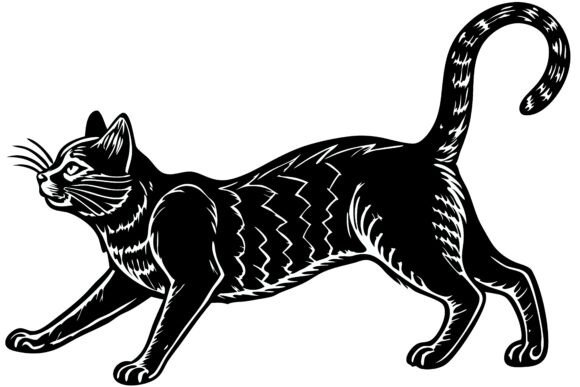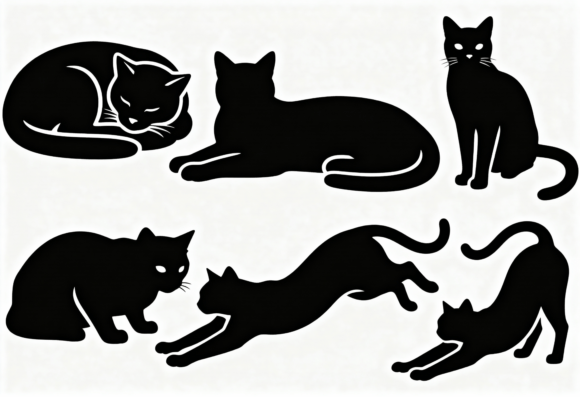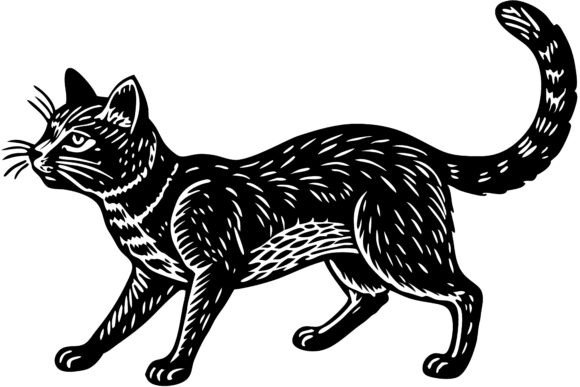
Black Cat Walking with Tail Raised
A Silhouette That Moves—Not Just Stands Still
First impression? This isn’t a static, stiff cat cutout—it’s a confident stride caught mid-step. The raised tail adds lift and attitude; the curve of the spine suggests motion, not posture. As an embroidery designer who’s stitched hundreds of animal motifs—from sleepy owls to prancing deer—I immediately saw how Black Cat Walking with Tail Raised avoids the flatness that plagues so many silhouette graphics. It breathes. That matters when you’re turning a digital file into thread on fabric.
Where It Shines: Real Projects, Real Stitching
I tested Black Cat Walking with Tail Raised as the centerpiece for a custom embroidered canvas tote bag—intended for a local boutique’s “Whimsical Pet Lover” collection. On natural linen-cotton blend fabric, with medium-weight tear-away stabilizer and 40-weight rayon thread, the shape held clean lines without bleeding or puffing. The tail’s fine tip, the slight taper of the legs, even the subtle curve where neck meets shoulder—all translated cleanly in satin and fill stitch. No digitizing cleanup needed.
It works just as well on soft baby onesies (with lightweight cut-away stabilizer and gentle hooping), on structured cotton aprons for a handmade kitchen brand, or as a standalone embroidered patch sewn onto denim jackets. I also used it on a set of tea towels for a holiday craft fair—paired with simple red thread on off-white fabric—and customers consistently paused to trace the outline with their fingers. That tactile appeal? Rare in a single-silhouette design.
Where It Needs Thought—Not Avoidance
This isn’t a one-size-fits-all embroidery file. Its clean shape is forgiving, but not magic. On highly textured fabrics like bouclé or thick terry cloth, the leg definition blurs slightly—so I’d recommend simplifying the stitch path or opting for a running-stitch outline version if that texture is non-negotiable. On stretchy knits (think sweatshirts or ribbed tees), hoop tension and stabilizer choice become critical—test on scrap first, and consider adding a light layer of fusible mesh behind the hoop area.
For curved surfaces like caps or low-profile beanies, the design’s horizontal orientation and modest width (roughly 3–4 inches at full scale) make it viable—but avoid placing it too close to the bill seam or crown point. The tail’s upward arc helps it sit naturally on a rounded surface, unlike rigid vertical motifs that fight the grain.
Dark fabric demands attention: while the black silhouette reads beautifully on light backgrounds, reversing it for dark fabric requires either white thread (which can look chalky) or metallic—neither of which are included in the base files. So if your craft business sells on both light and dark apparel, plan your thread palette ahead of time.
Stitch Density & Detail Reality Check
The file delivers crisp edges—not overly dense, not skimpy. That balance means it stitches quickly on most home and small commercial machines, yet holds up through repeated washing on baby items or kitchen linens. I’ve seen similar-looking designs fail under laundering because they relied on ultra-fine satin borders or micro-fill zones; Black Cat Walking with Tail Raised avoids those traps. Its simplicity is intentional—not minimalism for its own sake, but clarity built for real-world wear.
What It Adds to Your Craft Business—Beyond the Stitch
As an Etsy seller and small shop owner myself, I know buyers don’t just buy cats—they buy mood, identity, and intention. This design leans into quiet confidence, not cutesy or spooky tropes. That makes it versatile across seasons and audiences: a gender-neutral baby gift, a subtle nod for a feline-loving wedding guest, or a signature motif for a boutique’s branding. Customers recognize authenticity in clean execution—and that trust lifts perceived value. A well-stitched Black Cat Walking with Tail Raised on a linen pillow cover feels intentional, not generic.
It also pairs effortlessly with other design assets—add a tiny paw print or moon icon nearby, or use it alone as a bold focal point. For printable mockups or digital product previews, the included PNG and JPG files render crisply at multiple sizes, and the SVG scales without loss for vector-based layout work.
Practical Designer Notes Before You Stitch
- Always test on scrap fabric—especially if using textured, dark, or stretchy material.
- Check thread color contrast before stitching a batch: black thread on black fabric won’t read, and light thread on light fabric may vanish.
- Review stitch density in your embroidery software—if it looks overly tight or sparse, adjust fill angles or reduce density by 5–10% for delicate fabrics.
- Confirm hoop size compatibility: this design fits comfortably in a 4×4 hoop at standard scale, but verify before resizing beyond 120%.
- Inspect small details—the tip of the tail and inner ear curve should remain distinct after stitching; if they collapse, add a tiny tack-down stitch or simplify the path.
- Test in black-and-white mockups to gauge visual weight on light vs. dark backgrounds.
- Use appropriate stabilizer: tear-away for stable wovens, cut-away for knits, and fusible for lightweight silks or linens.
- Verify licensing before selling finished products or bundling the digital embroidery file—this is a Graphics asset, not pre-digitized machine embroidery, so digitizing for stitch is your responsibility.
Final Thought: A Design That Earns Its Place
Black Cat Walking with Tail Raised doesn’t shout. It walks in, settles, and belongs—whether on a nursery wall, a coffee shop apron, or a holiday gift tag. For crafters, Etsy sellers, and small shop owners, it’s more than a Crafts category download. It’s a reliable, expressive, quietly professional design asset—one that supports your voice instead of competing with it. Use it thoughtfully, stitch it with care, and let the cat do the rest.